
The Surprisingly Long History of Lorem Ipsum
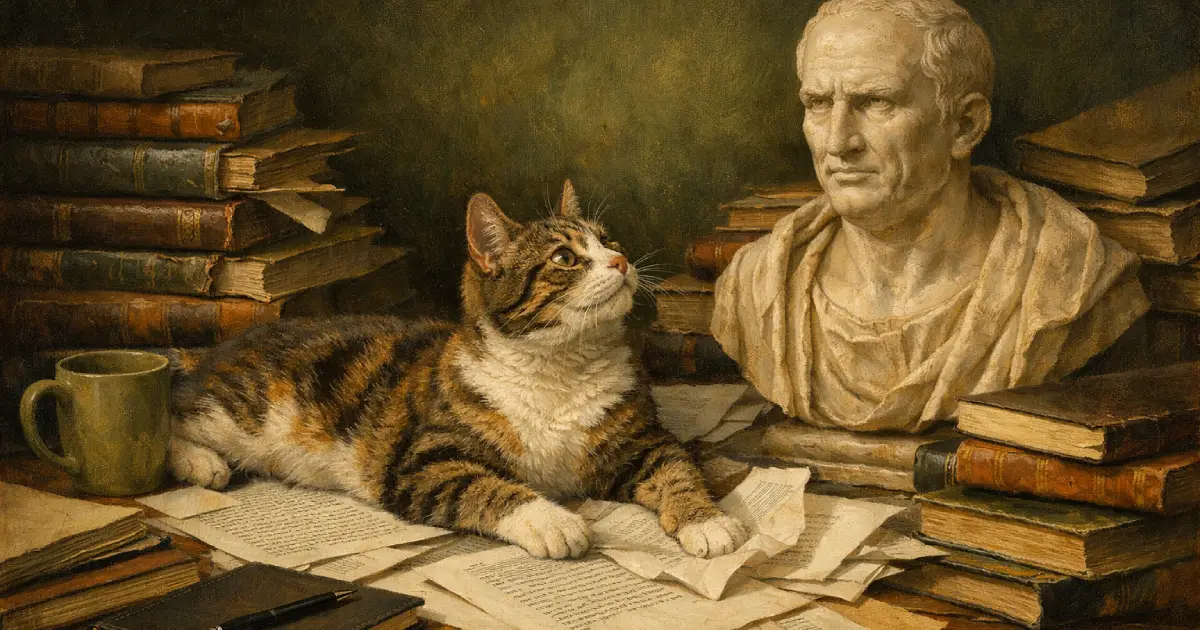
Open almost any design mockup, print template, or CMS theme demo and you’ll find the same passage staring back at you: “Lorem ipsum dolor sit amet, consectetur adipiscing elit…”
Most designers treat it as neutral static — text-shaped noise with no meaning or origin. In reality, Lorem Ipsum has one of the stranger backstories in typographic history, stretching from ancient Roman philosophy to a 1960s Letraset catalogue to every Figma file opened today.
It Started with Cicero (Sort Of)
The passage traces back to De Finibus Bonorum et Malorum — “On the Ends of Good and Evil” — a philosophical work written by the Roman statesman Marcus Tullius Cicero in 45 BC. In it, Cicero laid out competing ethical frameworks of the Epicurean and Stoic schools, arguing in elegant Latin about pleasure, virtue, and the good life.
The Lorem Ipsum passage is a scrambled, truncated excerpt from Book I, Section 32. The original reads:
“Neque porro quisquam est, qui dolorem ipsum quia dolor sit amet, consectetur, adipisci velit…”
Roughly translated: “Nor is there anyone who loves, pursues, or desires pain itself because it is pain…”
Whoever first used it as filler text in the 1500s didn’t reproduce Cicero faithfully — they shuffled the words, dropped syllables, and chopped sentences mid-clause. The result looked Latin-ish enough to read as placeholder prose without accidentally conveying any actual meaning. Whether that was deliberate or just careless is lost to history.
The 1500s: Type, Galleys, and an Unknown Printer
The conventional story — repeated in countless design articles — is that an unknown printer in the 1500s took a galley of Cicero’s text and scrambled it to produce a specimen book demonstrating typefaces. The idea being: Latin text would be familiar enough to educated European readers to look credible, but garbled enough not to distract from the typography itself.
This makes logical sense. Printers of the era needed to show how a typeface looked in actual paragraph settings, and filling pages with meaningful text risked readers engaging with the content rather than the letterforms. Nonsense that looked like sense was the ideal solution.
The specific printer, city, and date remain unknown. But the tradition stuck — and Lorem Ipsum became typesetting’s quiet constant for the next four centuries.
1960s: Letraset and the Modern Revival
Lorem Ipsum’s journey into mainstream design culture came via Letraset, the dry-transfer lettering sheets that were ubiquitous in pre-digital graphic design. Letraset used Lorem Ipsum passages on its sheets to demonstrate how typefaces and layouts would look in use.
When desktop publishing arrived in the 1980s — Aldus PageMaker being the landmark application — it shipped with Lorem Ipsum as its default placeholder text, cementing its role in digital design workflows. Every tool that followed took the same default, and here we are.
Why Scrambled Latin Still Works
It’s a fair question. We’ve had centuries to replace Lorem Ipsum with something better — real English, structured nonsense, anything. But the scrambled Latin has some genuine advantages that keep it relevant:
- It looks like language without reading as language. Your brain registers word shapes and rhythm without decoding meaning, which keeps focus on layout and type.
- It has no connotations. A passage of English prose, however neutral, carries tone. Lorem Ipsum is tonally invisible.
- It’s universal. A mockup shared with a team in Tokyo, Berlin, and São Paulo reads as placeholder text everywhere.
That said, for many modern projects these advantages are actually limitations in disguise. When stakeholders can’t engage with the text, they miss content-related layout problems entirely. And when you’re designing for a specific industry or language, generic Latin actively misleads.
That’s why there are now more targeted alternatives — from Corporate Ipsum and Legal Ipsum for professional mockups, to AI Ipsum and Cybersecurity Ipsum for tech products, to 60+ real-language generators for internationalisation work.
If you want the original, though — the one with two thousand years of history behind it — you can still generate it the Classic Lorem Ipsum way.
A Passage Older Than Most Countries
There’s something quietly remarkable about the fact that a mangled excerpt from a Roman philosophical text is still appearing in Figma files in 2026. Cicero was arguing about Epicurean ethics. Somewhere along the way, his words became the invisible scaffolding of almost every designed thing.
He would almost certainly have had opinions about that.
Browse all placeholder text generators at PlaceholderText.org/themed/.